




Is Your Aging Water Heater Ready for Winter Demands?
Are you wondering if your aging plumbing will survive another sudden temperature drop, or are you already dreading the thought of cold showers when holiday guests arrive? When seeking out options comparisons for homeowners, one of the most critical decisions you face in mid-fall is whether to keep repairing a failing system or replace it proactively. At Mack's Plumbing, TX LLC, our team frequently helps Forney homeowners navigate this exact dilemma. If your conventional water heater is over 10 years old, you might already be noticing the warning signs: a rusty tint to your hot water, strange rumbling noises from the tank, or temperatures that fluctuate wildly during a single shower.
The core decision point usually comes down to this: upgrading to a continuous tankless system versus installing a familiar, traditional tank. Mid-fall or pre-winter is the absolute optimal window to make this upgrade. Once the freezing weather hits, incoming municipal water temperatures drop significantly. This forces aging units to work much harder to heat the water, drastically lowering their recovery rates and exposing hidden system weaknesses.
Rather than waiting for a complete failure on the coldest day of the year, taking action now ensures you have reliable hot water when you need it most. By exploring professional plumbing services, you can ensure a safe, code-compliant installation that protects your home and keeps your family comfortable all season long.
The Mechanics of Traditional Tank Water Heaters
To make an informed decision between tankless vs conventional tank water heaters, you first need to understand how the familiar traditional system operates. These units are a staple in most homes because their design is straightforward, and the replacement process is generally simple if the existing infrastructure is already in place.
Here is a step-by-step look at how a traditional storage tank provides hot water to your home:
1. Cold water intake: Municipal water enters the bottom of the tank through a dip tube.
2. Heating process: A gas burner or electric heating element warms the water to your thermostat's setting (usually around 120°F).
3. Storage and standby: The tank holds 40 to 50 gallons of heated water, keeping it hot and ready for immediate use.
4. Distribution: When you open a hot water tap, pressure forces the heated water out of the top of the tank and through your pipes.
Because these systems are so common, securing expert plumbing installation and repair is a familiar process. However, the traditional design has notable downsides. The most significant is standby heat loss. Because the tank must constantly keep 50 gallons of water hot 24 hours a day, it consumes energy even when you are sleeping or away at work. Furthermore, once you drain that stored hot water during consecutive showers—a common issue when hosting holiday guests—you have to wait for the entire tank to refill and reheat before anyone else can bathe comfortably.
You also have to consider the physical footprint. A 50-gallon tank takes up substantial floor space in a utility closet, garage, or attic, which limits how you can use that square footage.
Vulnerabilities in Unconditioned Spaces
Throughout Forney and the surrounding areas, our technicians at Mack's Plumbing, TX LLC routinely see traditional tanks installed in unconditioned garages or attics. These areas lack insulation and climate control, making them highly susceptible to sudden temperature drops. When a severe winter freeze hits, the structural integrity of an aging metal tank is put under immense stress. The cold ambient air rapidly pulls heat away from the unit, forcing it to run almost constantly to maintain its internal temperature, which drastically shortens its remaining lifespan.
Exploring Tankless Water Heaters: Continuous Supply and Efficiency
If you want to eliminate the problem of running out of hot water entirely, tankless systems offer a modern solution. Instead of storing hot water in a massive reservoir, these units utilize on-demand heating technology. When you turn on the hot water tap, cold water flows through a highly efficient heat exchanger. A powerful gas burner rapidly heats the water to your exact target temperature as it passes through the unit.
Because they only consume energy when you are actively running the hot water, tankless systems completely eliminate standby energy loss. This on-demand approach makes them incredibly efficient over the long term. You also gain significant space-saving benefits. A tankless unit is roughly the size of a small suitcase and mounts directly to the wall, freeing up valuable floor space in your utility room or garage.
However, making the switch requires careful planning. Upgrading from a standard tank to a tankless unit is not a simple swap. These high-powered systems require specific venting solutions to exhaust combustion gases safely. They also demand a larger volume of gas over a shorter period, meaning your existing gas lines may need to be upsized to handle the increased load safely.
One local homeowner reached out to our team at Mack's Plumbing, TX LLC recently, concerned about potential gas pipe leaks after a previous, improper installation. One of our licensed technicians arrived, painted the gas pipe to protect it from corrosion, and thoroughly tested the system to ensure no leaks were present. That level of meticulous safety checking is exactly why upgrading to a tankless system requires experienced local professionals who understand Texas plumbing codes and gas line requirements. It is never a job for an amateur.
As an added benefit, generic federal tax credits and local utility rebates frequently apply to qualifying high-efficiency tankless upgrades. While you should always verify current programs with your utility provider, these incentives can help offset the initial installation costs.
Handling Holiday Household Spikes
Tankless systems excel during the holidays. If you have family visiting, you know the struggle of scheduling showers around the water heater's recovery time. Because an on-demand system heats water continuously as it flows, it completely eliminates the wait time. As long as you have water and gas flowing, you have hot water, allowing multiple guests to shower back-to-back without a drop in temperature.
Head-to-Head: Winter Performance and Capacity
To make the best choice for your home, you need a direct, objective comparison of how both systems perform, especially as the weather turns cold. Evaluating tankless vs conventional tank water heaters requires balancing your immediate budget against your long-term comfort.
Below is a clear breakdown of how both systems handle the specific challenges of winter weather and daily household demands.
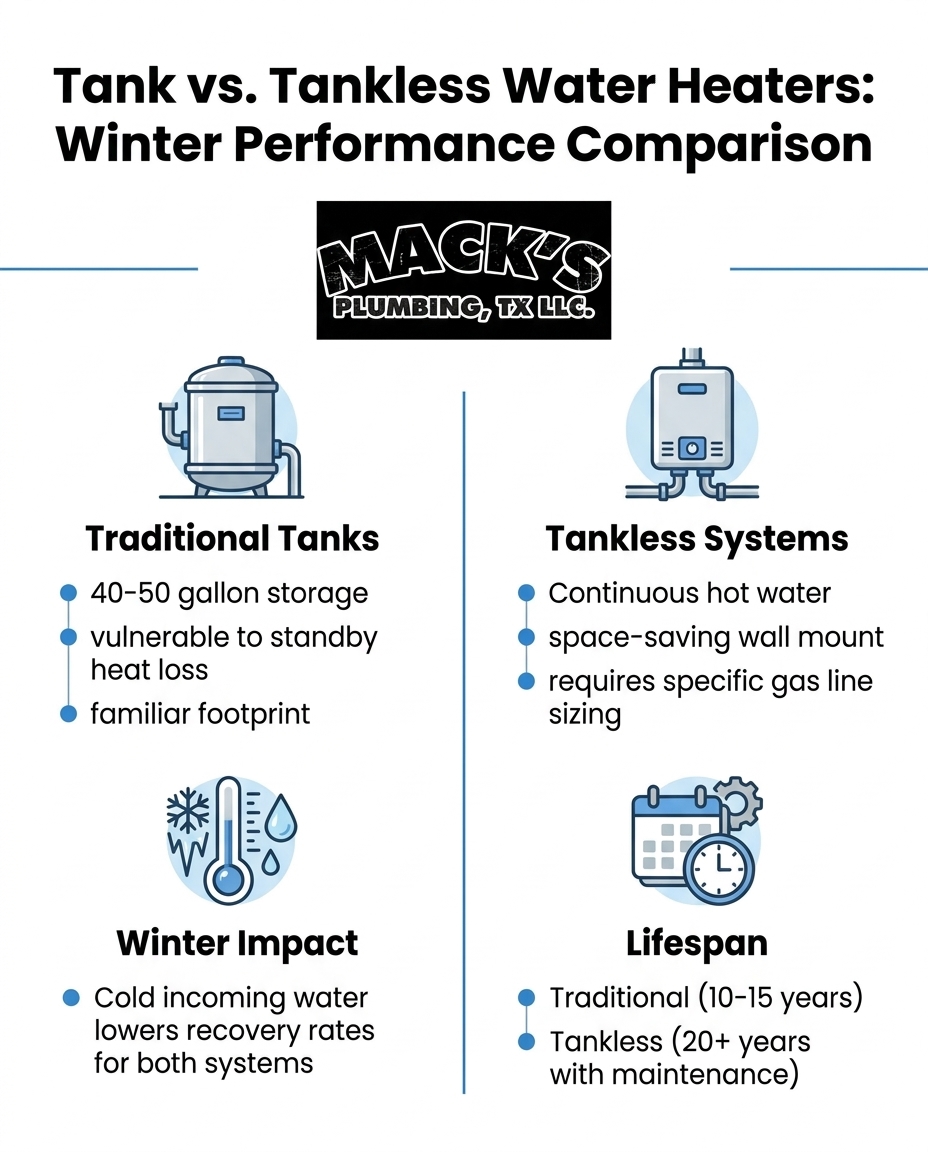
• Hot Water Supply — Traditional Tank Water Heater: Limited to the tank's capacity (usually 40-50 gallons). Will run out during heavy use. — Tankless Water Heater: Continuous, on-demand supply. Never runs out, ideal for back-to-back showers.
• Upfront Complexity — Traditional Tank Water Heater: Straightforward installation. Usually uses existing gas lines and venting. — Tankless Water Heater: Higher complexity. Often requires upsizing gas lines and modifying exhaust vents.
• Winter Cold Water Impact — Traditional Tank Water Heater: Cold incoming water drastically increases the time it takes to reheat the full tank. — Tankless Water Heater: Cold incoming water requires the burner to work harder to achieve the target temperature rise.
• Physical Footprint — Traditional Tank Water Heater: Requires significant floor space in a garage, attic, or utility closet. — Tankless Water Heater: Compact, space-saving wall mount design frees up floor space.
• Lifespan — Traditional Tank Water Heater: Typically lasts 10 to 15 years before the metal tank begins to rust and fail. — Tankless Water Heater: Can last 20+ years with proper annual maintenance and descaling.
Safeguarding Your Upgrade Against Catastrophic Leaks
Beyond choosing the right heating method, you must address the secondary risks of water heater failures. Aging traditional tanks are highly prone to rusting from the inside out. As the metal weakens, the tank becomes a ticking time bomb. When stressed by sudden Texas winter freezes—especially in unconditioned garages or attics—the expansion and contraction can cause the weakened metal to burst entirely.
Just this past summer, a local homeowner reached out to us at Mack's Plumbing, TX LLC with a sudden plumbing leak that threatened their property. Our team arrived on a day's notice, spotted the underlying issue, and fixed the leak completely, even managing the related masonry work. While fast emergency response saves the day, proactive prevention is always the smarter path for your home.
To protect your property from sudden bursts, integrating modern safety technology is essential. Automatic water shut-off valves are smart devices installed on your main water line or directly at the water heater. These sensors instantly detect abnormal water flow or pooling moisture. The moment a leak is detected, the valve automatically stops the water flow, preventing a minor drip from turning into a flooded home. Learning how automatic water shut-off systems protect your home is a vital step in modernizing your plumbing infrastructure.
The Role of Supplemental Drainage
If your water heater is located in a basement or lower-level utility area, shut-off valves are just the first line of defense. Proper drainage is equally important. In the event of a severe weather event or a catastrophic tank failure, sudden water accumulation can cause thousands of dollars in structural damage. Implementing reliable drainage and backup systems ensures that any escaped water is quickly routed away from your foundation and living spaces.
Making the Right Choice for Your Household Demand
Synthesizing all this information means evaluating your specific household needs before the deep winter cold arrives. The best choice always depends on balancing your long-term energy efficiency goals with your current infrastructure capabilities.
Start by calculating your peak hot water demand. Think about your busiest morning routine. Are you running a shower, starting the dishwasher, and doing a load of laundry simultaneously? Every fixture has a flow rate measured in gallons per minute (GPM). A standard showerhead uses about 2.5 GPM, while a dishwasher might use 1.5 GPM. If you need 4 GPM simultaneously, a tankless unit must be sized correctly to heat that volume of water instantly, even when the incoming municipal water is freezing cold.
You must also factor in the physical location of the unit. If your water heater lives in an unconditioned space, freeze protection is a major consideration. Tankless units have internal freeze protection, but the exposed pipes leading to them must be heavily insulated. If you live in an area prone to pooling water during storms, you might also want to explore sump pump solutions to keep the utility area dry and protect your new investment.
Ultimately, we recommend a professional assessment by our team at Mack's Plumbing, TX LLC as the safest way to determine which system fits your home's specific plumbing and gas setup. Guessing on sizing or capacity often leads to buyer's remorse and cold showers.
Frequently Asked Questions About Water Heater Upgrades
Is a tankless water heater better than a tank?
It depends entirely on your household's hot water demand and your energy efficiency goals. Tankless systems offer continuous hot water and eliminate standby energy loss, making them highly efficient over time. However, traditional tanks offer lower upfront installation complexity and utilize your existing gas lines without requiring major modifications. If you frequently run out of hot water during back-to-back showers, tankless is usually the superior choice.
Do tankless water heaters work well in cold climates?
Yes, tankless water heaters perform exceptionally well in cold weather, provided they are sized correctly. During winter, the incoming municipal water temperature drops significantly. The tankless unit must be powerful enough to achieve the necessary "temperature rise" to heat that freezing water up to 120°F at your required flow rate. Proper sizing by a professional ensures you never experience lukewarm water during a freeze.
What are the disadvantages of a tankless water heater?
The primary disadvantage is the higher initial installation complexity. Because they heat water instantly, they require a massive amount of gas upfront, which often means upsizing your home's gas lines. They also require specialized venting to safely exhaust combustion gases. Additionally, tankless units rely on electricity to ignite the burners and run the internal computer, meaning you will not have hot water during a power outage without a battery backup.
How long do tankless water heaters last compared to tanks?
Tankless units generally boast a much longer lifespan, often lasting 20 years or more when properly maintained. Traditional storage tanks typically last 10 to 15 years before the constant exposure to water causes the internal metal to rust and leak. To reach that 20-year mark, a tankless system requires annual descaling to remove mineral buildup from the heat exchanger.
Which water heater is best for large families during winter?
A properly sized tankless unit is almost always ideal for large families. With a traditional tank, the third or fourth person taking a shower will inevitably run out of hot water and have to wait for the tank to recover. A tankless system provides a continuous, endless supply of hot water, preventing the household from fighting over shower times during busy winter mornings.
How does cold weather affect tankless water heaters in Texas?
Cold weather drops the temperature of the incoming municipal water, requiring the unit's heat exchanger to work harder and consume more gas to reach your set temperature. For units installed in unconditioned spaces like Texas garages or attics, the surrounding cold air can also pose a freezing risk to the pipes. While the units themselves have built-in freeze protection, the external plumbing must be properly insulated to prevent ice blockages.
Ensure Your Home is Winter-Ready with Expert Guidance
Making a confident replacement decision starts with a clear, objective breakdown of your options. Whether you value the familiar reliability of a traditional tank or the endless hot water and space savings of a tankless system, acting now ensures your home is prepared for whatever the season brings.
Do not wait until your aging water heater bursts on a freezing night or leaves your holiday guests shivering. Mid-fall is the perfect time to schedule a thorough evaluation of your plumbing infrastructure. By connecting with our reliable team of plumbers in Forney and surrounding areas, you can discuss your options safely, professionally, and without the stress of an emergency situation. Protect your home, upgrade your comfort, and enjoy the peace of mind that comes with a winter-ready plumbing system.

Customer Testimonials

Robert with Macks Plumbing has saved my repair/reno project so much time and money by finding the problems that other plumbers couldn’t. He is easy to work with, direct and honest. Couldn’t recommend him with more confidence.
Quick response, knowledgeable and courteous. Techs that came for water heater made sure everything cleaned up and working properly. Will use Mack's again when I need work in future.
Excellent service. Prompt & professional. Great communication on arrival time and repairs needed. Easy to work with. We will use them again.
Showed before the expected time and both guys were polite, knowledgeable and more than ready to get the job done. I will definitely be using them again and recommending them to everyone I can!

Financing
We make it easy to get the plumbing services you need with flexible financing options through Wisetack, including zero down plans with approved credit.