




Preparing Your Home for Fall: The Hidden Demands of Gas Appliance Conversions
As the early fall transition settles over North Texas, our team at Mack's Plumbing, TX LLC knows it is the perfect time to start evaluating residential gas line installation for fall appliance conversions. Before the first winter cold snap hits, many homeowners begin planning upgrades to their heating systems or adding outdoor fire features to enjoy the crisp evenings. However, a common problem we see arises when you try to add new gas-powered equipment without first verifying if your home's current gas system has the capacity to handle the extra demand.
The critical decision point is determining whether your planned upgrades will require a brand-new, dedicated gas line or if your existing infrastructure can safely support the load. Guessing is never an option when dealing with natural gas. Relying on professional plumbing services ensures your entire system is assessed accurately from the start. A proactive evaluation not only maps out the necessary upgrades but also provides a comprehensive check for gas leak detection and safety before the heavy winter usage begins.
Common signs you need a system evaluation:
• New outdoor additions: Planning a fire pit, outdoor kitchen, or patio heater.
• Indoor heating upgrades: Switching from an electric furnace to a high-efficiency gas model.
• Appliance changes: Moving from a standard electric water heater to a gas-powered system.
• Noticeable performance drops: Existing gas appliances struggling to operate simultaneously.
Taking action during the early fall transition means you avoid the winter rush, secure the necessary municipal permits faster, and ensure your home is fully prepared for the freezing temperatures ahead.
Demystifying the BTU Load Calculation for Residential Gas Systems
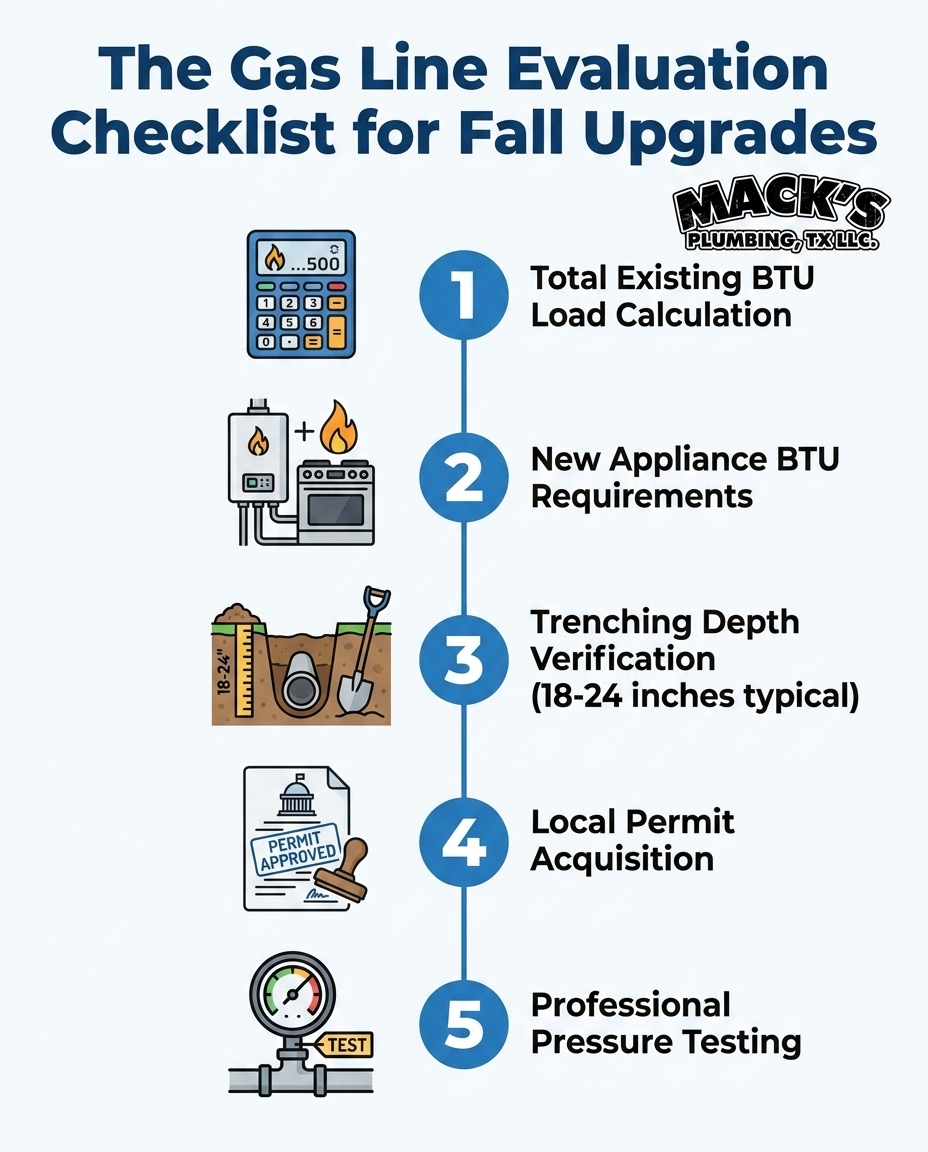
Before connecting a single new appliance, our licensed professionals perform a precise BTU load calculation. BTU stands for British Thermal Unit, which is the standard measurement of heat energy. Every gas appliance in your home—from the stove to the furnace—draws a specific number of BTUs per hour. The gas meter and the pipes running through your home can only deliver a finite amount of gas volume at a given pressure.
When you combine indoor heating upgrades with new outdoor fire features, you can easily exceed your existing system's maximum capacity. An undersized gas line forces appliances to compete for fuel. This leads to poor performance, incomplete combustion, and dangerous safety hazards, including the potential release of carbon monoxide. This mathematical assessment is equally critical during major kitchen and home remodels where high-BTU professional-grade gas ranges are installed.
The standard process for calculating system capacity:
1. Inventory current appliances: A technician records the BTU rating of every existing gas appliance in the house.
2. Measure pipe distances: Gas loses pressure the further it travels, so the distance from the meter to each appliance is measured.
3. Determine pipe diameter: The size of the existing pipes dictates how much volume can flow through them safely.
4. Add the new load: The BTU requirements of the planned fall appliance conversions are added to the total.
5. Compare against meter capacity: The grand total is checked against the physical limits of the gas meter and the primary manifold.
Why Existing Lines Often Fall Short
Most original home gas lines are sized specifically for the appliances installed at the time of construction. As we often explain to our customers, builders rarely install oversized pipes "just in case" because it adds unnecessary material costs. Therefore, adding modern, high-efficiency appliances—which may qualify for general utility incentive programs or federal tax credits—almost always requires a recalculation of the total system draw.
Visual inspections simply cannot replace mathematical BTU load calculations. A pipe might look large enough, but if it is already supplying a water heater and a furnace, tapping into it for an outdoor fire pit could starve all three units of adequate fuel. Upgrading the system often means running a new, dedicated line directly from the meter to the new appliance to ensure safe, consistent operation.
Navigating Trenching and Outdoor Gas Lines in North Texas Soil
Installing outdoor gas lines for fall fire features or external heating units involves unique physical and environmental challenges. In our years serving Forney, TX, we've seen firsthand how the region's expansive clay soil can wreak havoc on underground utilities. During the shift from hot, dry summers to cooler, wetter fall temperatures, the clay soil contracts and expands significantly. This constant shifting exerts immense pressure on underground utility lines.
Because of this volatile soil, strict trenching depth requirements are enforced to protect gas lines from surface weight and underground movement. Proper pipe bedding techniques are essential. A trench cannot simply be dug and filled back in with hard clay clods. The pipe must rest on a bed of soft sand or specialized material that cushions it, preventing stress fractures and potential leaks as the ground shifts around it.
Prompt, professional underground assessments are vital when dealing with foundation-level or buried plumbing infrastructure. Last fall, our team at Mack's Plumbing, TX LLC helped a local homeowner who faced an urgent leak under their foundation just as temperatures began to drop. While other companies quoted weeks for an assessment, our dedicated technician arrived the next day, provided a clear estimate, and completed the underground repair professionally while explaining the entire process. This level of responsiveness is crucial when dealing with buried gas lines that could be compromised by shifting soil.
Material Selection for Underground Lines
You cannot use the same materials underground that you use inside the walls of your home. The soil environment is highly corrosive and requires specialized products.
• Polyethylene (Poly) Pipe: This is the standard for direct burial. It is flexible, resistant to corrosion, and handles ground shifting well. It must be installed with a tracer wire so utility locators can find it in the future.
• Black Iron Pipe Restrictions: Standard black iron pipe is completely unsuitable for direct burial. The moisture in the soil will rust it away rapidly unless it is wrapped in specialized, factory-applied protective coatings.
• Protective Sleeving: Where an underground gas line rises and enters a concrete foundation or masonry wall, it must be encased in a protective sleeve. This prevents the abrasive concrete from wearing a hole through the pipe as the house naturally settles.
Safety Codes and Local Permitting: Protection, Not Red Tape
It is easy to view local municipal permits as frustrating administrative hurdles, but they are actually essential protective measures for you and your property. The guidelines for residential systems are established by NFPA 54, the National Fuel Gas Code. This comprehensive manual dictates everything from pipe sizing and threading requirements to the exact procedures for testing a system before it goes live.
Our team works closely with local municipalities in and around Forney, TX, which require permits for any new gas line installation or major alteration to ensure these national safety standards are met. Bypassing the permit process might save a little upfront, but it exposes you to massive liabilities. Unpermitted gas work can instantly void your homeowners' insurance policy. If a fire or explosion occurs due to an illegal installation, the financial ruin falls entirely on the homeowner.
What a permitted inspection entails:
• Professional pressure testing: Before the gas is turned on, the new line is capped and pressurized with air. A gauge monitors the line for a specified period (often 15 to 30 minutes). If the pressure drops even slightly, there is a leak that must be found and fixed.
• Material verification: The municipal inspector verifies that the correct type of pipe, fittings, and sealants were used for the specific application.
• Depth and bedding checks: For outdoor lines, the inspector will often require the trench to remain open so they can verify the pipe is buried at the correct depth and bedded in the proper material.
Evaluating Specific Fall Upgrades: Fire Pits, Furnaces, and Water Heaters
Different fall appliance conversions place very different demands on your residential gas system. Grouping these installations during the early fall transition is a smart strategy. It minimizes permit fees, reduces the number of times your yard needs to be trenched, and ensures your entire system is balanced simultaneously.
Outdoor fire features, for instance, are notorious gas hogs. A large outdoor fire pit can easily demand over 100,000 BTUs per hour—more than an entire standard home furnace. Because they are located away from the house, they almost always require dedicated underground lines run directly from the primary meter.
Furnace conversions require a careful evaluation of the primary manifold inside the home. If you are upgrading from an electric heat pump to a gas furnace, the interior gas piping must be routed to the utility closet safely, ensuring it does not interfere with existing ductwork or electrical lines.
Water heating upgrades present another unique challenge. If you are planning a tankless water heater installation, you must account for massive on-demand BTU requirements. While tankless units are highly efficient over time, they require a massive surge of gas to instantly heat water as it flows through the unit. This surge often requires upgrading the gas line diameter from a standard 1/2-inch pipe to a 3/4-inch or even 1-inch pipe.
• Standard Gas Water Heater (Tank) — Typical BTU Demand: 30,000 - 50,000 BTUs — Common Installation Requirements: Standard 1/2-inch indoor piping, standard venting.
• Gas Furnace (Residential) — Typical BTU Demand: 60,000 - 100,000 BTUs — Common Installation Requirements: Dedicated branch line, specific clearance requirements.
• Tankless Water Heater — Typical BTU Demand: 150,000 - 199,000 BTUs — Common Installation Requirements: Upgraded 3/4-inch or 1-inch piping, specialized venting.
• Outdoor Fire Pit / Fireplace — Typical BTU Demand: 60,000 - 150,000+ BTUs — Common Installation Requirements: Dedicated underground poly line, trenching, tracer wire.
The Risks of DIY Gas Work: Why Licensed Expertise is Non-Negotiable
The internet is filled with home improvement tutorials, but gas line evaluation and installation is strictly a job for licensed professionals. The extreme dangers of improper gas line installation cannot be overstated. A poorly threaded pipe, the wrong type of thread sealant, or an incorrect BTU load calculation can lead to undetected leaks, carbon monoxide buildup, and severe combustion risks.
Specialized equipment is required to perform this work safely. Licensed plumbers use highly sensitive manometers for accurate pressure testing and electronic combustible gas detectors to verify connections. These tools are far more accurate than the old "soap and water" method often touted in online DIY forums. Furthermore, the legal and safety ramifications of attempting a BTU load calculation without proper training can leave your home under-fueled and unsafe.
We frequently see the fallout from DIY attempts. Recently, our crew helped a local customer who dealt with a persistent plumbing problem that multiple previous companies failed to fix. Once our licensed professionals properly diagnosed the underlying issue, we provided a lasting solution and made it work safely. This highlights why expertise matters. Mack's Plumbing, TX LLC is committed to rigorous safety standards, proper permitting, and professional execution. We emphasize that licensed expertise is non-negotiable for gas line work, ensuring every job meets municipal codes and prioritizes the safety of your family. If you suspect an existing issue before starting a new project, scheduling safe gas leak detection and repair is the first critical step.
Frequently Asked Questions About Gas Line Installation
Do I need a permit to run a new gas line?
Yes, you almost always need a permit to run a new gas line or alter an existing one. Local municipalities require these permits to ensure the work complies with the National Fuel Gas Code. An inspector will verify the materials, trench depth, and pressure tests to guarantee the installation is safe for your home.
How do you calculate BTU load for a gas line?
You calculate the BTU load by adding up the hourly BTU rating of every gas appliance connected to the system. A professional plumber will then measure the length and diameter of your pipes to determine if the existing infrastructure can deliver that total volume of gas without dangerous pressure drops.
How deep does an outdoor gas line need to be buried?
An outdoor gas line typically needs to be buried between 18 and 24 inches deep, depending on local Forney, TX codes. This depth protects the pipe from surface activities like gardening or aeration, and helps insulate it against extreme temperature changes and shifting expansive clay soil.
Can a plumber install a gas line?
Yes, licensed plumbers are the exact professionals trained and certified to install gas lines. While people often associate plumbers strictly with water pipes, licensed plumbing contractors carry the necessary credentials to perform safe, code-compliant gas pipe installation and pressure testing.
Why can't I use my existing gas line for a new outdoor fire pit?
You usually cannot use an existing line because outdoor fire pits require a massive amount of BTUs. Tapping into a line that already feeds your furnace or water heater will likely starve all the appliances of fuel, leading to poor performance and serious safety hazards.
Make Confident Decisions for Your Fall Gas Line Projects
Safe gas appliance conversions rely on precise BTU sizing, proper trenching techniques, and strict adherence to local municipal permits. The early fall transition is the ideal time to get these evaluations done, ensuring your home is ready for cooler weather without the stress of emergency winter scheduling.
Understanding these critical factors allows you to confidently hire and collaborate with licensed professionals like Mack's Plumbing, TX LLC. You now know why load calculations matter and why permits protect your property. Schedule your comprehensive system evaluation before the busy winter season begins, so you can enjoy your new gas heating upgrades and outdoor fire features with total peace of mind.

Customer Testimonials

Robert with Macks Plumbing has saved my repair/reno project so much time and money by finding the problems that other plumbers couldn’t. He is easy to work with, direct and honest. Couldn’t recommend him with more confidence.
Quick response, knowledgeable and courteous. Techs that came for water heater made sure everything cleaned up and working properly. Will use Mack's again when I need work in future.
Excellent service. Prompt & professional. Great communication on arrival time and repairs needed. Easy to work with. We will use them again.
Showed before the expected time and both guys were polite, knowledgeable and more than ready to get the job done. I will definitely be using them again and recommending them to everyone I can!

Financing
We make it easy to get the plumbing services you need with flexible financing options through Wisetack, including zero down plans with approved credit.